
If you track consumer complaints from the CFPB public database — for research, risk monitoring, or investment signals — here is a structural break you need to know about before your next chart.
The break
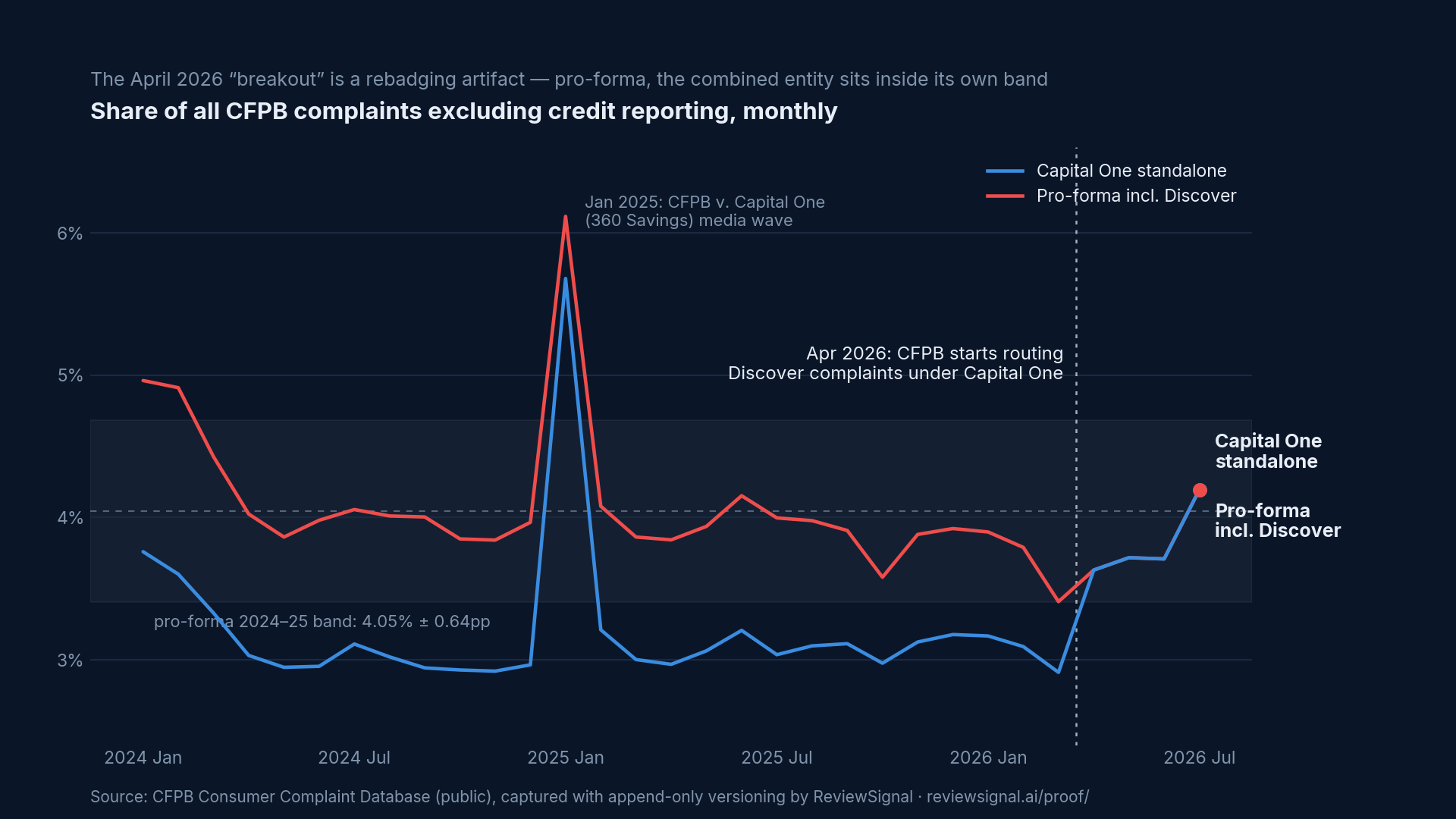
Capital One completed its acquisition of Discover on May 18, 2025. For the next ten months, both companies kept receiving complaints under their own names in the CFPB registry. Then, starting April 2026, complaints against Discover began landing under the Capital One umbrella: DISCOVER BANK’s complaint flow drops from a steady ~530–700 per month to exactly zero in April 2026, and never comes back.
Why it bites
Chart Capital One’s complaints on their own — or its share of all CFPB complaints — and you will see what looks like a clean, sustained breakout beginning April 2026: from a two-year band of roughly 2.9–3.3% of all non-credit-reporting complaints up to 4.2% by July.
It is not a breakout. It is Discover’s complaint flow being rebadged. We know because we initially read it as a signal — and killed it in our own review before it went anywhere. Every month of that “breakout” is explained by the rerouted Discover volume.
The fix
Treat Capital One and Discover as one pro-forma entity across the full history. Combined, the picture inverts: the merged entity’s share of non-credit-reporting complaints averaged 4.05% (±0.32pp monthly, 2024–2025) and stands at 3.8–4.2% through July 2026 — statistically indistinguishable from its own baseline. As of the latest data, there is no detectable rise in normalized complaint friction at the combined company. One month at z = +0.5 is noise; our own alert threshold is z > +2 sustained for two months.
Two smaller traps in the same dataset
While you are patching your pipeline:
- The credit-reporting product label changed around August 2023. “Credit reporting or other personal consumer reports” has zero records before then. Filter by the new label only and you silently lose all history.
- Credit-reporting complaints now dominate the registry — roughly 90% of monthly volume in 2026, heavily template-driven. Any per-company series that does not exclude or separate them is mostly measuring that flood, not the company.
Method note
We capture the CFPB database with append-only versioning — a record edited by the regulator becomes a new row, never an overwrite — normalize against registry-wide volume, and run entity-level controls before reading any series as a signal. That process is what caught this artifact within hours. It is the same discipline behind our public, pre-registered prediction ledger at reviewsignal.ai/proof/.
ReviewSignal tracks consumer-facing operational data — 780,000+ location reviews across 19,000+ locations and 79 chains, updated daily — alongside independent panels like app-store reviews and official regulator records. Frankfurt am Main.